

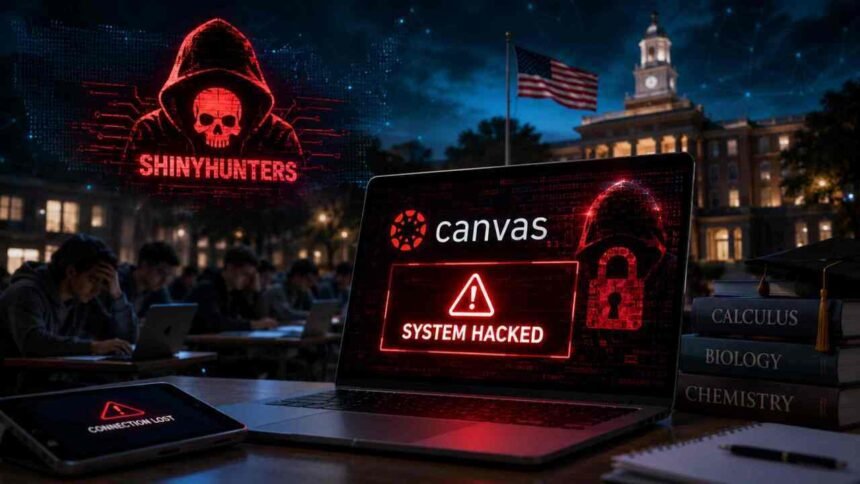
A cyberattack targeting the widely used Canvas learning platform triggered widespread disruption at schools and universities across the United States this week, leaving students and educators scrambling during one of the busiest periods of the academic year.
The incident affected access to coursework, assignments, exams, and messaging systems at institutions that rely on Canvas for day-to-day classroom operations. Some universities warned students about outages and login issues as the platform was temporarily taken offline for emergency maintenance.
The disruption arrived at a particularly difficult moment for many campuses, with final exams and end-of-semester deadlines underway.
Canvas is operated by education technology company Instructure and is used by thousands of schools worldwide, including major universities across the U.S.
The attack has drawn national attention not only because of the outage itself, but because cybersecurity researchers say it reflects a growing trend where hackers increasingly target centralized digital platforms used by massive numbers of institutions at once.
Hackers operating under the name “ShinyHunters” claimed responsibility for the breach and reportedly attempted to pressure the company into negotiating over stolen data.
The group allegedly claimed that thousands of educational institutions were impacted, though the full scope of the incident remains unclear.
Instructure confirmed that certain user information linked to affected institutions may have been accessed, including names, email addresses, student ID numbers, and messages exchanged on the platform. The company said there was no evidence that passwords, financial data, or government identification numbers were exposed.
During the outage, some schools reportedly experienced additional problems after attackers allegedly altered parts of Canvas login pages with warning messages related to the breach.
Cybersecurity analysts say the incident highlights how dependent modern education systems have become on cloud-based learning infrastructure.
Rather than targeting individual universities separately, attackers appear to have focused on a central platform used by thousands of schools simultaneously, dramatically increasing the scale of disruption.
Experts also warn that data extortion tactics are evolving beyond traditional ransomware attacks.
Instead of simply encrypting systems, some hacker groups now rely on public pressure campaigns, leak threats, and reputational damage to force organizations into negotiations.
Security researchers tracking ShinyHunters say the name has been associated with several major breaches involving corporations, universities, and online services over the past few years. However, experts caution that different cybercriminal groups sometimes reuse well-known hacker identities online, making attribution difficult.
By Thursday evening, Canvas services had largely returned for many users, though some institutions continued monitoring systems and assessing the potential impact of the breach.
The attack has also reignited concerns about how vulnerable educational institutions remain to large-scale cyber incidents, especially as more coursework, communication, and student records move into centralized digital platforms.
For students, the outage became more than just a technical problem. At many schools, it interrupted access to critical coursework and added stress during final exams, highlighting how deeply modern education now depends on a small number of online systems staying operational.
Also read: Chrome Users Are Just Realizing Google Installed a 4GB AI Model on Their PCs.
- Why Instagram Reach Feels Broken in 2026 — And What Actually Still Works

- These 7 Instagram Algorithm Tricks Are Working Surprisingly Well Right Now
- Thousands of KeyBank Customers Suddenly Lost Access to Their Accounts This Weekend
- Microsoft’s $1 Billion AI Data Center Plan in Africa Has Hit a Major Roadblock
- These 3 Hidden TikTok Signals Matter Most for Going Viral in 2026