
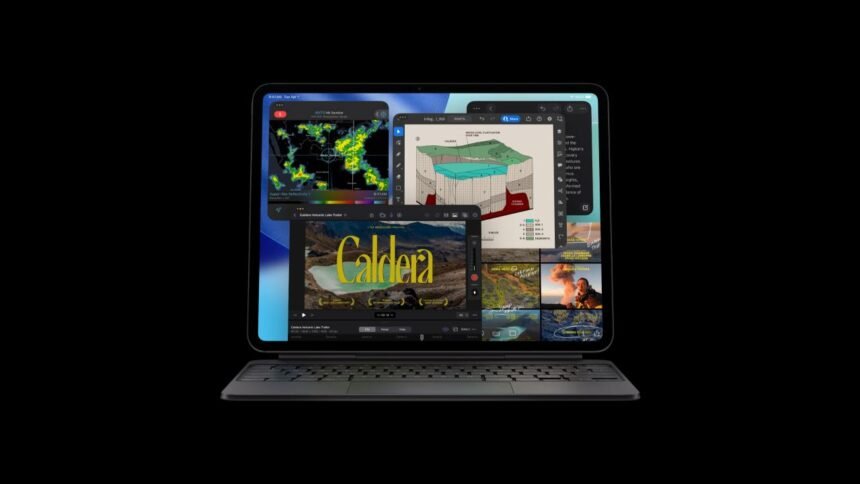
Apple’s latest iPad Pro has arrived — but this time, it feels like more than just another chip upgrade. The new M5-powered iPad Pro doesn’t simply promise faster numbers; it quietly signals Apple’s shift toward a device that actually thinks. With a redesigned Neural Engine, a GPU that carries a built-in AI accelerator in every core, and an OS that finally feels built for multitasking, the iPad has started acting less like a tablet and more like a lightweight studio.
The M5 leap: AI in every gesture
For years, Apple’s silicon story has been about efficiency. The M5 changes that language — it’s about intelligence. The 10-core GPU’s neural accelerators allow the device to handle AI-heavy tasks natively, whether that’s image generation in Draw Things, video masking in DaVinci Resolve, or Apple’s own on-device “Intelligence” features. Apple claims up to 3.5 × faster AI performance than M4 and 5.6 × over M1 — and early app demos already hint that those numbers might be more than marketing optimism.
A faster brain needs faster bandwidth
Every upgrade inside supports that AI ambition. Unified memory bandwidth now crosses 150 GB/s, storage read-writes have doubled, and even the base configurations offer 12 GB RAM. That means less waiting between tasks — the difference between watching progress bars and actually finishing work.
Wireless, redesigned for real mobility
Two new Apple chips push connectivity forward. The N1 handles Wi-Fi 7, Bluetooth 6, and Thread for a tighter web of devices. The C1X modem, found in cellular models, claims 50 % faster data while sipping less power — a quiet but crucial improvement for users who work untethered.
The display that outshines its frame
At just 5.1 mm thin (13-inch model), this iPad Pro somehow fits Apple’s Ultra Retina XDR tandem-OLED display — 1600 nits peak HDR, adaptive 120 Hz refresh, and even a nano-texture option for creators who work under harsh light. For the first time, the iPad can also drive external 120 Hz displays with adaptive sync, a feature that video editors and gamers will actually notice.
iPadOS 26: when the software finally catches up
The new OS redesigns the iPad experience with a proper windowing system, smarter Files app, and a dedicated Preview app for PDFs. The interface — built with “Liquid Glass” transitions — feels dynamic but focused, finally turning multitasking from a compromise into a habit. Add live translation, background tasks, and local AI processing, and the device begins to feel genuinely pro.
What it costs to enter Apple’s AI future
Prices start at $999 for the 11-inch Wi-Fi model and $1,299 for the 13-inch. The accessories, as usual, play an important role: Apple Pencil Pro with haptic feedback at $129, and the new Magic Keyboard with aluminum palm rest starting at $299. Both help the iPad live up to its “laptop alternative” promise.