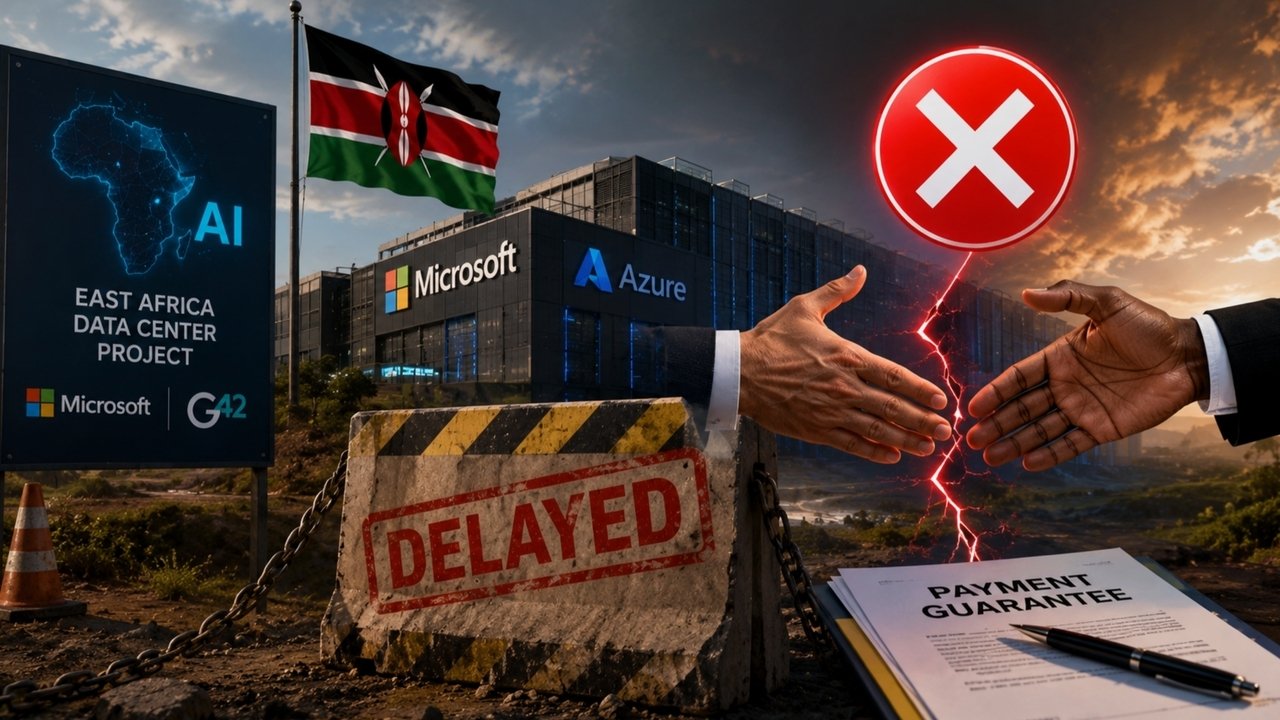

Microsoft’s ambitious push to expand cloud and AI infrastructure in Africa is reportedly facing unexpected complications after negotiations tied to a major data center project in Kenya stalled over payment guarantees.
The delay was first reported by Bloomberg, which cited people familiar with the discussions between Microsoft, its UAE-based AI partner G42, and the Kenyan government.
The proposed facility, announced in 2024, was expected to become one of East Africa’s most significant cloud infrastructure investments. Microsoft and G42 had pledged roughly $1 billion toward the project as part of broader efforts to expand artificial intelligence and cloud-computing services across the region.
The data center was also expected to support Microsoft Azure services through a dedicated East African cloud region.
One of the project’s most high-profile features involved sustainability. The facility was planned to run entirely on geothermal energy, positioning it as part of the growing global push toward greener AI infrastructure.
But reports now suggest the project has encountered challenges tied to demand guarantees.
Microsoft and G42 reportedly asked Kenya’s government to commit to purchasing a certain level of cloud capacity each year in order to support the long-term economics of the project. However, negotiations allegedly broke down after the requested guarantees exceeded what officials were willing or able to provide.
The disagreement has reportedly raised concerns that the project could eventually be scaled back.
Kenyan officials, however, insist discussions are still active.
Government representatives reportedly said the project has not been canceled or abandoned, but acknowledged that the scale and energy requirements of the proposed data center still require additional planning and restructuring.
The situation highlights a growing challenge facing the global AI and cloud infrastructure boom.
As companies race to build massive new data centers worldwide to support artificial intelligence services, the projects increasingly require:
enormous electricity supplies,
long-term infrastructure commitments,
government cooperation,
and guaranteed commercial demand.
That can make negotiations particularly complex in developing markets where energy systems and cloud demand are still expanding.
For Microsoft, the Kenya project was viewed as a strategic move to strengthen its presence in Africa’s rapidly growing technology sector while competing more aggressively with other global cloud providers.
The company has been investing heavily in AI infrastructure worldwide as demand for cloud-based AI tools and enterprise computing continues accelerating.
The uncertainty surrounding the Kenya facility also reflects how expensive and politically sensitive large-scale AI infrastructure projects are becoming globally.
As governments and technology companies negotiate over energy usage, funding structures, and long-term economic risks, even billion-dollar projects can face delays before construction fully moves forward.
Also read: These 3 Hidden TikTok Signals Matter Most for Going Viral in 2026.
- Why Instagram Reach Feels Broken in 2026 — And What Actually Still Works

- These 7 Instagram Algorithm Tricks Are Working Surprisingly Well Right Now
- Thousands of KeyBank Customers Suddenly Lost Access to Their Accounts This Weekend
- Microsoft’s $1 Billion AI Data Center Plan in Africa Has Hit a Major Roadblock
- These 3 Hidden TikTok Signals Matter Most for Going Viral in 2026
- Verizon’s Budget Carrier Just Added Disney+ and Global Roaming to Its Unlimited Plans
- Epic Games Just Made This Cozy Adventure Game Free on Mobile for a Limited Time
- PS5 Just Dropped Two Free Fantasy Games That Players Are Already Praising